Five Hundred Years Later: How Luther's Theological Revolution Still Echoes Through First Lutheran OKC's Pews
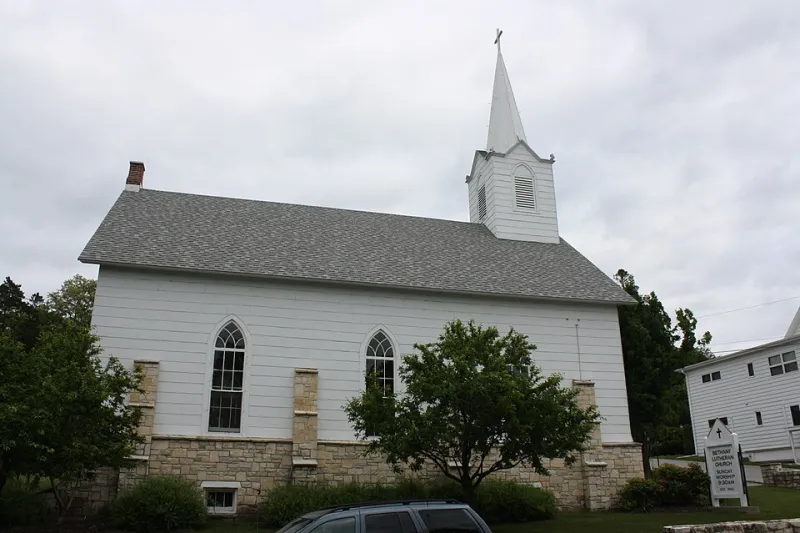
Photo: Royalbroil, CC BY-SA 3.0, via Wikimedia Commons
In October of 1517, an Augustinian friar named Martin Luther reportedly affixed ninety-five propositions to the door of the Castle Church in Wittenberg, Germany. He was not, by his own account, attempting to fracture Western Christianity. He was inviting a debate. What followed, of course, was far more consequential than any academic disputation — it was a seismic restructuring of how millions of Christians understood their relationship to God, to Scripture, and to the world they inhabited Monday through Saturday.
More than five centuries have passed. The context has shifted from medieval Europe to twenty-first-century Oklahoma City, from candlelit chancels to a congregation navigating smartphones, neighborhood food insecurity, and the spiritual restlessness of a post-pandemic culture. And yet, when members of First Lutheran OKC gather on Sunday mornings — and when they scatter back into their neighborhoods, workplaces, and homes afterward — they carry with them a set of theological convictions that trace directly back to that moment in Wittenberg. Understanding those convictions is not merely an exercise in church history. It is an invitation to recognize the living architecture beneath the congregation's worship, community life, and sense of purpose.
Justification by Faith: The Doctrine That Changed Everything
If one were to identify the single theological claim at the center of Luther's reform, it would be this: human beings are made right with God not through their own moral achievements, ritual performances, or accumulated merit, but through faith — a trust that receives the grace God freely offers in Jesus Christ. Luther called this the articulus stantis et cadentis ecclesiae — the article by which the church stands or falls.
For contemporary churchgoers accustomed to motivational spirituality and self-improvement frameworks, this doctrine can feel almost counterintuitive. It insists, with striking directness, that the weight of one's standing before God does not rest on personal effort. It has already been settled.
At First Lutheran OKC, this conviction shapes the tone of worship in ways that are subtle but unmistakable. The liturgy does not begin with an invitation to present one's best self. It begins with confession — an honest acknowledgment that the congregation arrives not as spiritual achievers but as people who need grace. The absolution that follows is not conditional or hedged. It is declarative. The pastor speaks it over the assembly as a word of assurance, not a transaction to be completed.
This pattern — law and gospel, confession and absolution, honest reckoning followed by genuine release — is not liturgical formality for its own sake. It is a weekly rehearsal of the theological reality Luther fought to recover: that the human condition is met not by human striving but by divine gift.
The Priesthood of All Believers: Flattening the Spiritual Hierarchy
Luther's second great contribution was perhaps even more socially disruptive than his soteriology. Against a medieval church structure that concentrated spiritual authority in an ordained clerical class, Luther argued that every baptized Christian stands before God as a priest — capable of direct access to the divine, empowered to intercede for others, and accountable for their own engagement with Scripture and prayer.
This was not an argument for religious individualism. Luther was deeply suspicious of the isolated conscience untethered from community and the Word. Rather, it was an argument for the spiritual dignity of ordinary people — that the farmer, the merchant, the midwife, and the schoolteacher were not spiritually second-class citizens who depended on clergy to mediate their relationship with God.
First Lutheran OKC embodies this inheritance in the texture of its congregational life. Lay members lead portions of the liturgy. Small group Bible studies are facilitated by non-ordained participants who are trusted to engage the text seriously. The congregation's outreach ministries — from food pantry coordination to neighborhood partnerships — are understood not as programs administered from above but as expressions of a community in which every member bears genuine spiritual responsibility.
This is not a flat, leaderless structure. The pastoral office is taken seriously at First Lutheran OKC, and the ordained ministry of Word and Sacrament carries real authority. But that authority functions within a congregation that understands itself as a community of priests — people who have each been claimed by baptism and set apart for a life of service and witness.
The Sacred in Secular Work: Vocation as Theological Category
Perhaps the most practically transformative dimension of Luther's legacy — and the one most relevant to the daily lives of First Lutheran OKC members — is his theology of vocation.
Before the Reformation, the concept of a sacred calling was largely reserved for those who entered religious orders. To become a monk, a nun, or a priest was to pursue a higher spiritual path. Ordinary work — raising children, tilling fields, practicing law, teaching school — was spiritually neutral at best, a distraction from eternal concerns at worst.
Luther inverted this entirely. He argued that God does not call people away from the world in order to serve Him. God calls people through their ordinary roles and responsibilities. The parent who rises at night to comfort a sick child, the physician who attends to a patient with care and skill, the neighbor who shows up in a moment of crisis — these are not secular activities that happen alongside a Christian life. They are the Christian life, lived out in the particular places and relationships where God has positioned each person.
This theology of vocation has concrete implications for how First Lutheran OKC frames its mission. The congregation does not measure spiritual health primarily by hours spent in church programming. It asks a different question: how are members living out their callings in the specific contexts where they spend their lives? The teacher in the classroom, the attorney in the courtroom, the parent in the carpool line — each of these is understood as a site of genuine Christian witness and service.
Sermons at First Lutheran OKC regularly engage this theme, not as an abstract theological point but as a pastoral encouragement to members who may not feel that their daily work carries spiritual significance. The Lutheran tradition insists that it does — and that recognizing this transforms not only how one approaches work but how one understands oneself as a participant in God's ongoing care for the world.
A Living Inheritance, Not a Frozen Monument
It would be a mistake to treat First Lutheran OKC's Lutheran identity as mere denominational branding — a historical label attached to a congregation that could just as easily operate under any other theological banner. The Reformation's theological commitments are not decorative. They are load-bearing.
They shape why the congregation confesses before it celebrates. They explain why laypeople are trusted with genuine spiritual leadership. They illuminate why members are encouraged to see their Monday-through-Friday lives as arenas of faithful service rather than interruptions to their religious practice.
Martin Luther did not intend to found a denomination. He intended to recover what he believed was the New Testament's central announcement: that God's grace is prior to human effort, that this grace is received through faith, and that it sends those who receive it back into the world with a renewed sense of dignity and purpose.
Five hundred years later, in a congregation on the plains of Oklahoma, that announcement continues to be made — in liturgy, in community, and in the lives of people who carry it with them long after the Sunday service has ended.