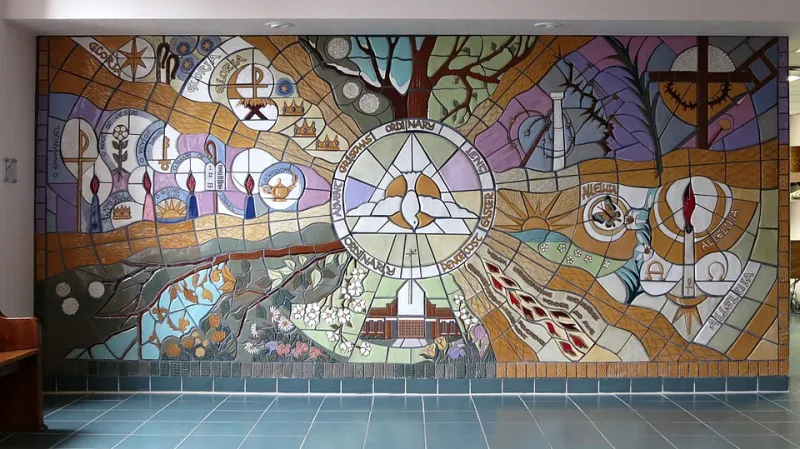
Monday Morning Faith: How First Lutheran OKC Brings the Sacred into the Secular Week
Photo: Wilfredor, CC0, via Wikimedia Commons
There is a particular kind of silence that settles over a church after the congregation has gone home. The candles are extinguished, the bulletins collected, the parking lot emptied. For many Christians, that moment marks the close of their weekly encounter with the holy. But for the members of First Lutheran OKC, the argument could be made that the most theologically significant hours of the week begin precisely when Sunday worship ends.
At the heart of Lutheran theological tradition lies a conviction that has never entirely lost its radical edge: God is not confined to sanctuaries. The incarnation—the entry of the divine into human flesh, into history, into the material world—was not a one-time event sealed away in ancient scripture. It is, rather, a continuing reality that reshapes how believers are called to move through ordinary life. First Lutheran OKC has made the deliberate pastoral choice to take that conviction seriously, not merely as doctrine to be affirmed, but as a practice to be lived.
What Incarnational Theology Actually Means
The term "incarnational theology" can sound abstract, even academic, but its implications are thoroughly practical. Derived from the Latin caro—flesh—it names the theological claim that God chose to enter creation not by bypassing the physical world but by inhabiting it. For Lutherans, this principle extends beyond the Christmas narrative. It undergirds the theology of the sacraments, which hold that ordinary bread, wine, and water become vehicles of divine grace. It also extends, crucially, into the theology of vocation.
Martin Luther's reformulation of vocation was, in its own era, a kind of revolution. He dismantled the medieval hierarchy that placed monks and clergy on a higher spiritual plane than farmers, midwives, and merchants. Every legitimate calling, Luther insisted, was a station through which God worked in the world. The parent caring for a sick child in the middle of the night was engaged in holy work. The teacher correcting papers, the nurse monitoring vitals, the contractor building a home—each was participating, whether consciously or not, in the ongoing creative and redemptive activity of God.
First Lutheran OKC draws directly from this tradition, and its ministry reflects an attempt to help congregants not simply understand this theology but internalize it.
The Gap Between the Pew and the Pavement
One of the more honest observations made within the congregation is that a gap frequently exists between what people believe on Sunday and how they operate on Monday. Oklahoma City is a city defined by its work ethic—energy sector professionals, healthcare workers, educators, small business owners, and tradespeople fill the pews at First Lutheran. Many of them live with a quiet compartmentalization: faith belongs to the weekend; the workweek belongs to a different set of rules.
The pastoral team at First Lutheran has named that compartmentalization directly and gently. In sermon series, small group discussions, and one-on-one conversations, the question is consistently raised: What would it mean to carry your baptismal identity into Tuesday afternoon? What changes if you genuinely believe that the person across the conference table, or the customer at the counter, or the unhoused neighbor on the street corner, bears the image of God?
These are not rhetorical questions for the congregation. They are invitations to a different kind of attentiveness.
Relationships as Theological Practice
One of the most tangible expressions of incarnational thinking at First Lutheran OKC is the way the congregation approaches relationships—both within the church and in the broader community. Rather than treating fellowship as a peripheral benefit of church membership, the congregation understands genuine human connection as a theological act.
To be fully present with another person—to listen without an agenda, to sit with someone in their confusion or grief, to celebrate their ordinary victories—is to participate in the kind of presence that the incarnation itself modeled. Jesus did not remain at a distance from human experience. He attended weddings. He shared meals with people whose reputations made them social liabilities. He touched those whom the culture deemed untouchable.
First Lutheran's community groups, outreach partnerships, and even its informal culture of hospitality are shaped by this understanding. Showing up matters. Presence is not incidental to the faith; it is one of its primary expressions.
Work, Ethics, and the Question of Integrity
For a congregation embedded in a city with a complex economic landscape, the theology of vocation raises pointed ethical questions. How does a person of faith navigate workplace pressures that conflict with their values? What does it mean to pursue professional excellence while refusing to treat people as instruments?
First Lutheran does not offer tidy answers to these tensions. What it does offer is a theological framework that takes them seriously. If work is a vocation—a calling through which God operates in the world—then the quality of one's character at work is not separate from one's spiritual life. Honesty in business dealings, fairness in management decisions, advocacy for colleagues who lack power: these are not merely ethical preferences. Within the incarnational framework, they are expressions of faithfulness.
Several members of the congregation have spoken, in small group settings, about how this framing has changed the way they approach difficult professional situations. The question is no longer simply "What is legal?" or even "What is conventional?" but "What does faithfulness require of me here?"
Community Service as Sacramental Act
First Lutheran OKC's outreach work in Oklahoma City is extensive and varied, touching food security, housing advocacy, refugee support, and neighborhood revitalization. What distinguishes the congregation's approach to service is the theological weight it assigns to that work.
Service is not, in this tradition, primarily about demonstrating institutional goodwill or fulfilling a civic obligation. It is understood as an encounter with the incarnate God. The words attributed to Jesus in the Gospel of Matthew—"Whatever you did for one of the least of these brothers and sisters of mine, you did for me"—are taken with full seriousness. To serve a neighbor in need is to serve Christ. The soup kitchen is, in a real sense, a sanctuary.
This conviction does not romanticize poverty or suffering. It does, however, refuse to allow the congregation to maintain a comfortable distance from the city's pain. Oklahoma City has its share of visible need, and First Lutheran's members are encouraged to see that need not as a problem to be managed from afar but as an invitation to incarnational presence.
Finding the Holy in the Habitual
Perhaps the most quietly radical aspect of First Lutheran OKC's theological culture is the invitation to find the sacred in the genuinely unremarkable. Not every moment will feel transcendent. Not every act of service will produce visible results. Not every workday will offer a clear sense of divine purpose.
But the tradition insists that God is present in those hours too—in the repetition, the frustration, the ordinary maintenance of life. The Lutheran practice of offering daily prayers, of pausing before meals, of marking transitions with brief moments of gratitude, is a discipline designed to cultivate that kind of attentiveness. It is, at its core, a practice of learning to notice.
For the members of First Lutheran OKC, Sunday morning remains the gathering point—the place where the community is formed, fed, and sent. But it is not the destination. It is the launching pad for a week lived, however imperfectly, in the awareness that the sacred has not retreated from the world. It has taken up residence in it.