Seasons of the Soul: What the Church Calendar Teaches Us About Letting Go
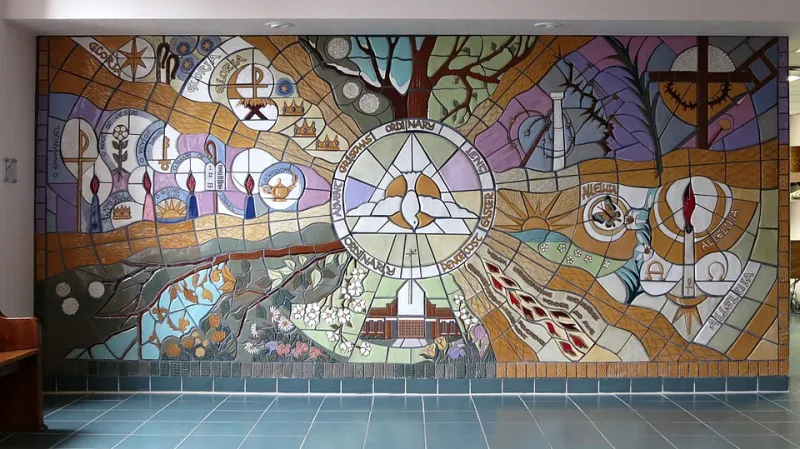
Photo: Nheyob, CC BY-SA 3.0, via Wikimedia Commons
There is something quietly countercultural about a community that still organizes its life around seasons. In a culture that prizes relentless forward momentum — productivity apps, five-year plans, curated timelines — First Lutheran Church in Oklahoma City gathers each week inside a rhythm that is older than the nation itself. The liturgical calendar does not ask whether you are ready to move on. It simply moves, as seasons do, and invites you to move with it.
For many people sitting in those pews, that invitation has become one of the most profound spiritual lessons of their adult lives.
A Framework Built for Human Limits
The Christian year begins not with triumph but with waiting. Advent, the season that opens the liturgical calendar each November or December, is structured around expectation and incompleteness. Candles are lit one at a time. Familiar carols are held back. The congregation is asked, week after week, to sit with longing rather than rush toward resolution.
Pastor Elaine Horstmann, who has served First Lutheran OKC for nearly a decade, describes Advent as the season that most honestly mirrors the human condition. "We live most of our lives in a kind of waiting," she says. "Waiting for a diagnosis, waiting for a relationship to heal, waiting to see whether a decision we made will prove wise. Advent doesn't pretend that waiting is easy. It just says: you are not alone in it, and it is not without purpose."
This framing — that incompleteness is not a malfunction but a season — has resonated deeply with parishioners navigating real-world uncertainty. For Sandra Meyers, a longtime member who returned to First Lutheran OKC after a twenty-year absence from regular church attendance, it was an Advent sermon that first cracked something open in her.
"I had just taken early retirement. My kids were grown and scattered. I didn't know who I was outside of my career," she recalls. "The pastor talked about how Advent teaches us to hold space for things that haven't arrived yet. I started to wonder if I could apply that to my own life — if I could stop grieving the chapter that had closed and start waiting, faithfully, for whatever came next."
Lent and the Discipline of Release
If Advent teaches waiting, Lent teaches something harder still: the willingness to set things down.
The forty days of Lent, which precede Easter, have long been associated with fasting and self-examination. But at First Lutheran OKC, the pastoral team has been intentional about framing Lenten practice less as deprivation and more as a spiritual exercise in non-attachment. The question Lent poses, Pastor Horstmann suggests, is not merely "What will you give up?" but "What are you holding so tightly that it has begun to hold you?"
For David Okafor, a First Lutheran OKC member who navigated a significant career transition two years ago, that question proved unexpectedly clarifying. After nearly fifteen years in a management role he had worked hard to achieve, his company underwent a restructuring that eliminated his position. He arrived at Lent that year carrying what he describes as a grief he did not fully understand.
"I kept telling myself I should be fine. I had savings. I had options. But I felt this profound sense of loss that I couldn't name," he says. "The Lenten liturgy gave me language for it. We were reading texts about Jesus in the wilderness, about stripping away everything that was not essential. I realized I had tied my identity to that title, that role. Lent helped me begin the work of releasing it."
This connection between liturgical practice and the psychological work of identity reconstruction is not incidental. Scholars of both theology and human development have noted that ritual provides a container for experiences that are otherwise too large or too formless to process. The church calendar, in its insistence on moving through darkness before arriving at light, mirrors the actual shape of grief and growth in ways that more optimistic frameworks often do not.
Pentecost and the Surprise of New Beginnings
The liturgical year does not end with Easter's resurrection, though it would be easy to assume that the story climaxes there. Fifty days later comes Pentecost — the season of the Holy Spirit, marked in many Lutheran congregations by a shift to red vestments and a renewed emphasis on the church's outward calling in the world.
Pentecost carries a particular energy that longtime members of First Lutheran OKC describe as renewing. After the long arc of Advent's waiting, Lent's release, and Easter's joy, Pentecost arrives as an invitation into something genuinely new. It is the season of movement, of wind and fire, of gifts being distributed and communities being formed.
For parents navigating the particular grief of an empty nest — a transition that many describe as simultaneously joyful and devastating — the Pentecost season has offered an unexpected frame. "My youngest left for college the same week Pentecost began that year," recalls Margaret Tillman, who has attended First Lutheran OKC with her husband for more than two decades. "The sermon that Sunday was about how the Spirit moves into spaces that have been emptied out. I wept through the whole service. But it was a different kind of weeping than I had expected. It felt like permission — permission to grieve the ending and also to be curious about what the Spirit might do in the space that had opened up."
The Pastoral Work of Seasonal Accompaniment
What makes the liturgical calendar more than an intellectual framework, according to First Lutheran OKC's pastoral team, is the community that moves through it together. No one navigates a season of loss in isolation at this congregation if the congregation can help it.
Small groups organized around the church year provide what Pastor Horstmann calls "seasonal companionship" — structured opportunities for members to name what they are carrying and to hear how the ancient texts speak into contemporary struggle. These gatherings have become, for many participants, among the most meaningful pastoral resources the church offers.
"People come in talking about job loss or divorce or a health scare, and within a few weeks they realize they are actually talking about something deeper — about their relationship with control, with certainty, with their own identity," Pastor Horstmann observes. "The liturgical seasons give us a shared vocabulary for that conversation. They remind us that these experiences have always been part of what it means to be human, and that the church has always had something to say to them."
Learning to Live in the Turn
Perhaps the most counterintuitive gift of the church calendar is this: it does not allow any single season to become permanent. Advent gives way to Christmas. Lent gives way to Easter. Ordinary Time, with its long green stretch of weeks, eventually circles back around to Advent again. The wheel turns, whether we are ready or not.
For a congregation situated in Oklahoma City — a community that has known its own seasons of devastation and resilience — this rhythm carries particular weight. The city itself has learned, often painfully, that recovery is not linear and that new life does not erase what was lost. It simply insists on growing alongside it.
At First Lutheran OKC, the liturgical year is not treated as a relic of another era but as a living resource for navigating the present one. In its seasons of waiting, releasing, grieving, and renewing, the calendar holds out a simple but radical invitation: to trust that the turn, however disorienting, is not the end of the story.
For those willing to follow that rhythm — pew by pew, season by season — it has proven to be one of the most quietly transformative practices the Christian tradition offers.