The Gift of Uncertainty: How First Lutheran OKC Holds Space for Those Who Question
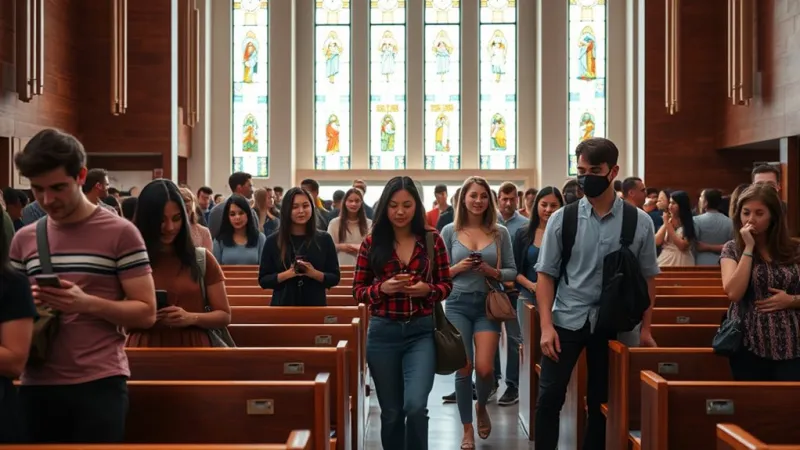
There is a particular kind of loneliness that accompanies spiritual doubt. It is not simply the absence of certainty — it is the fear that admitting uncertainty will cost you your community, your identity, or your standing before God. For many Americans who grew up in religious households, doubt was treated as a symptom to be corrected rather than a question to be explored. At First Lutheran OKC, however, a different posture has taken root — one that treats uncertainty not as a failure of faith, but as one of its most honest expressions.
A Congregation Willing to Ask Hard Questions
Pastor and congregational leadership at First Lutheran OKC have long maintained that the Lutheran tradition carries within it a remarkable capacity for intellectual and spiritual honesty. Martin Luther himself was, at his core, a man who refused to accept inherited answers without examination. That spirit of rigorous inquiry has shaped how this Oklahoma City church approaches the reality that many of its members — past, present, and prospective — arrive carrying serious doubts about God, Scripture, or organized religion itself.
"We don't ask people to check their questions at the door," said one longtime member who asked to be identified only by her first name, Carol. "When I came back to church in my late thirties, I had spent years convinced that my doubts made me unworthy of being here. What I found instead was that people here had been carrying the same questions — quietly, sometimes painfully — for decades."
Carol's experience is not unusual. Across the congregation, members describe an informal but deeply felt culture of permission — permission to say, without shame, I am not sure I believe this anymore, or I never fully believed it to begin with.
Doubt as a Spiritual Practice
The theological case for embracing doubt is older than most modern congregations acknowledge. The Psalms are saturated with lament, confusion, and even accusation directed at God. The book of Job is, at its heart, a prolonged argument between a suffering man and the divine. Thomas, perhaps the most misunderstood figure in the New Testament, is remembered not for his doubt but for his willingness to voice it aloud — and for the response he received.
At First Lutheran OKC, adult education programming has increasingly reflected this tradition. Small group discussions, Wednesday evening gatherings, and seasonal study series have incorporated texts and conversations that take seriously the experience of those who find belief difficult. Rather than offering tidy apologetic answers, facilitators are trained to sit with the discomfort of unresolved questions.
"I came to one of the Wednesday groups expecting to be argued back into belief," recalled Marcus, a member in his mid-forties who describes himself as having spent several years as a functional agnostic while still attending services. "Instead, the group leader opened by saying that she herself had seasons where prayer felt like speaking into an empty room. That one admission changed everything for me."
For Marcus, the acknowledgment that doubt is not a private aberration — but a shared human experience that even mature believers navigate — was the beginning of a slow and careful return to active faith. He is careful to note, however, that his faith today looks different from the uncomplicated certainty of his childhood. "It's more honest," he says. "It's mine in a way it never was before."
The Pastoral Response to Skepticism
Not every person who walks through the doors of First Lutheran OKC arrives as a believer. Some come at the invitation of a spouse or a friend. Others come out of cultural habit, or grief, or a vague hunger they cannot quite name. The pastoral staff at First Lutheran OKC has worked to ensure that these individuals — sometimes called seekers, sometimes skeptics — are not met with pressure or a sense that they must perform belief in order to belong.
This approach is, in some respects, countercultural within American Christianity, where membership and doctrinal affirmation are often closely linked. At First Lutheran OKC, the emphasis falls on presence and relationship first. Theological questions, it is understood, tend to find their footing most naturally within genuine community rather than in formal instruction delivered from a distance.
"We believe that people encounter grace before they can fully articulate what grace means," one staff member noted during a recent community forum. "Our job isn't to resolve every question before someone feels welcome. It's to make sure they feel welcome enough to keep asking."
When Silence Feels Like Absence
Perhaps the most tender dimension of spiritual doubt is the experience of divine silence — the season in which prayer feels unanswered, Scripture feels hollow, and the God who once seemed near feels wholly absent. This is not a marginal experience. Mystics, theologians, and ordinary believers across centuries have described it. Saint John of the Cross called it the dark night of the soul. Mother Teresa, it was later revealed, endured decades of it.
At First Lutheran OKC, members who have navigated these seasons speak of the importance of not having to navigate them alone. Several describe how remaining connected to the congregation — even when personal faith felt threadbare — ultimately became the thread that held.
"I kept showing up even when I felt nothing," said one woman who joined the congregation during a period of profound personal loss. "Not because I was pretending. But because the people here kept showing up for me. Eventually, I realized that was itself a kind of answer."
This is, in many ways, the quiet argument that First Lutheran OKC makes through its culture rather than its curriculum: that community is not merely a supplement to faith but one of its primary carriers. When individual belief falters, the gathered body continues. When one person's voice goes silent, others carry the song.
An Invitation, Not a Requirement
First Lutheran OKC does not present itself as a congregation of the certain. It presents itself as a congregation of the committed — committed to one another, to honest inquiry, and to a God who, in the Lutheran understanding, meets humanity not in its triumphant moments but in its most vulnerable ones.
For those in Oklahoma City who have walked away from church because they could not reconcile their questions with the expectations they encountered elsewhere, this congregation extends a quiet invitation: come as you are, with every doubt intact. You will not be fixed here. You may, however, find that you are not as alone as you feared — and that the questions you have been carrying are not obstacles to faith, but among the most faithful things about you.
Information about upcoming small group gatherings, adult education series, and pastoral conversations is available at firstlutheranokc.org.