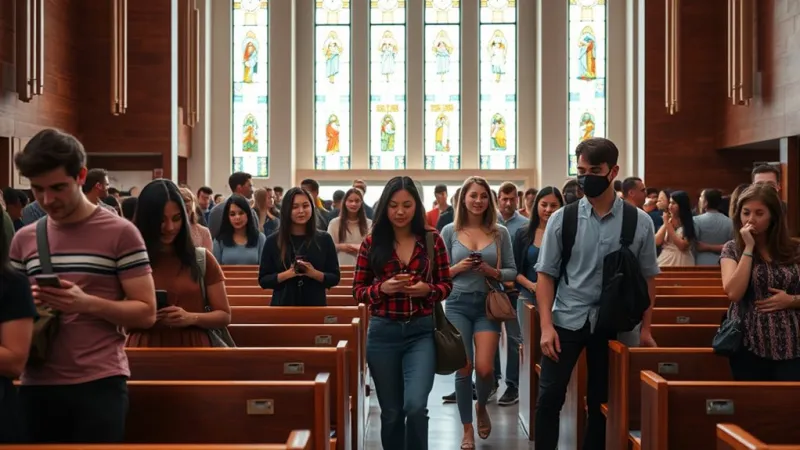
The Sacred in the Small: How Everyday Moments Become Holy Ground for First Lutheran OKC Members

Photo: Pamornkong, CC BY-SA 4.0, via Wikimedia Commons
There is a particular kind of silence that settles over Oklahoma City just before sunrise. The highways are still quiet, the coffee is still brewing, and the day has not yet made its demands. For Margaret Hollis, a longtime member of First Lutheran OKC and a registered nurse who begins her shifts before dawn, this is not merely the beginning of a workday. It is, she says, the beginning of a conversation with God.
"I used to think prayer had to look a certain way," Margaret explains. "Hands folded, eyes closed, sitting in a pew. But somewhere along the way I realized that talking to God during my drive down I-35 was just as real as anything I'd ever done in a sanctuary."
Margaret's experience is far from unique within the congregation at First Lutheran OKC. Across the pews—and across the neighborhoods, kitchens, and office buildings of Oklahoma City—members of this community are discovering what theologians have long affirmed: that the sacred is not reserved for formal religious settings. It permeates the texture of ordinary life, available to anyone willing to pay attention.
Bread, Butter, and the Presence of God
For David and Carmen Reyes, a couple who joined First Lutheran OKC three years ago after relocating from San Antonio, the kitchen has become an unlikely sanctuary. Carmen, who grew up watching her grandmother prepare traditional Mexican dishes, began to notice a shift in how she experienced cooking after a sermon series on Lutheran theology's understanding of vocation—the idea, rooted in Reformation thought, that everyday work and care for others is itself a form of worship.
"Pastor spoke about how Luther believed that the milkmaid doing her work faithfully was serving God just as surely as the priest at the altar," Carmen recalls. "That landed differently for me. I started thinking about what it means to feed people—really feed them—as an act of love and faith."
Now, Carmen says, Sunday meal preparation has taken on an almost meditative quality. She prays over the ingredients, thinks of the people who will gather around the table, and considers the act of nourishment as participation in something larger than herself. Her husband David, an electrician, has found a similar rhythm in his own work.
"Every house I wire, someone is going to live in it," he says. "Families are going to turn on lights, cook meals, keep their kids warm in winter. I started seeing that as connected to my faith in a way I never had before."
The Commute as Contemplative Practice
Oklahoma City is a driving city. Residents spend significant portions of their lives behind the wheel, navigating stretches of highway and surface streets that can feel like lost time. Several First Lutheran OKC members, however, have deliberately reframed the daily commute as a period of intentional spiritual practice.
James Whitfield, a high school history teacher who drives nearly forty minutes each way to his school in Edmond, began listening to recorded sermons and Lutheran devotional podcasts during his commute after a conversation with a fellow congregation member. What surprised him, he says, was not the content of what he heard but how the act of listening changed his mental and emotional state before entering a classroom.
"I was arriving to work stressed and already reactive," James admits. "Now I arrive having spent time thinking about grace, about purpose, about why I do what I do. It changes how I treat my students. It changes how I handle the hard moments in the day."
Others have taken a different approach, using the commute for silence and simple, spoken prayer rather than audio content. The principle, as members describe it, is less about the specific practice and more about the intention behind it—the deliberate choice to acknowledge God's presence before the noise of the day takes over.
Parenting as Spiritual Formation—for Parents
Perhaps no daily experience is simultaneously more exhausting and more spiritually rich than parenthood. Several parents within the First Lutheran OKC congregation have spoken openly about how raising children has deepened their faith in ways they did not anticipate.
Sarah Okonkwo, a mother of three young children and a member of the church's parents' small group, describes the experience with characteristic honesty. "There are moments when I am so depleted that I have nothing left to offer," she says. "And it is in those moments that I have had to trust in something beyond myself in a way that no amount of comfortable living ever required of me."
Sarah notes that the Lutheran theological concept of grace—the understanding that we are accepted and sustained not by our own perfection but by God's unmerited love—has taken on profound personal meaning in the context of parenting. "I fail my kids sometimes. I lose patience. I say the wrong thing. And then I have to extend grace to myself the way I would extend it to them. That is theology lived out in real time."
For other parents in the congregation, bedtime prayers with children have become anchoring rituals—simple, repetitive, and quietly transformative. What begins as a practice for the child, many discover, becomes equally formative for the adult.
Small Practices, Lasting Formation
What emerges from these stories is not a prescriptive program or a set of spiritual techniques to be adopted wholesale. Rather, it is an invitation to attentiveness—to notice where grace is already at work in the hours between Sunday mornings.
At First Lutheran OKC, this understanding is woven into the community's broader theological identity. Lutheran Christianity has historically resisted the division of life into sacred and secular spheres, insisting instead that all of life is held within God's care and concern. Vocation, relationships, work, and rest are not interruptions to the spiritual life—they are the material through which the spiritual life is lived.
For those who feel that faith has become compartmentalized—something practiced on weekends but disconnected from the weight and texture of the week—these congregation members offer a gentle challenge. The commute, the kitchen, the classroom, the bedside: these are not lesser places. They are, as First Lutheran OKC members have found, precisely where the sacred tends to show up.
"I used to wait for the big spiritual moments," Margaret Hollis reflects, as the Oklahoma sky begins to lighten outside her windshield. "Now I've learned to look for the small ones. And honestly, there are far more of them than I ever realized."
First Lutheran OKC welcomes all who are seeking community, spiritual depth, and a faith that speaks to the fullness of daily life. Visit us at firstlutheranokc.org to learn more about our congregation, upcoming events, and ways to connect.