Returning to the Pew: What First Lutheran OKC Understands About Young Adults That Many Churches Don't
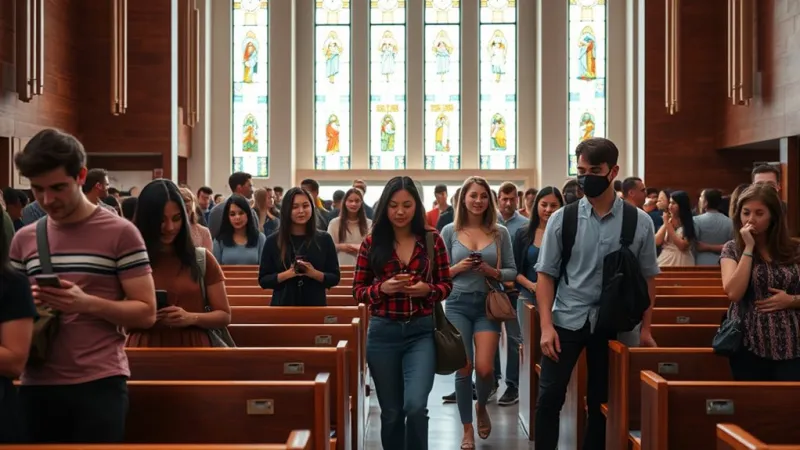
Photo: young adults millennials attending church service together in modern Lutheran church Oklahoma, via jesusanswers.org
For the better part of two decades, the dominant narrative about young Americans and organized religion has been one of departure. Millennials left the church in notable numbers. Gen Z followed. Sociologists catalogued the rise of the "nones"—those who claim no religious affiliation—and religious institutions across the country braced for what many assumed would be a prolonged, perhaps irreversible, decline.
And yet something more complicated appears to be happening. Not a wholesale reversal of those trends, but a more nuanced movement: a quiet return, in select communities, of young adults who are seeking something that the secular world has not been able to provide. In Oklahoma City, First Lutheran OKC has found itself at the center of this phenomenon—drawing young adults who grew up unchurched, former Christians who drifted away, and a generation that is, by all accounts, spiritually curious even when it is institutionally skeptical.
Understanding why requires honesty about both the failures of the church and the genuine needs it can meet.
The Weight of Institutional Failure
Any serious conversation about young adults and the church must begin with an acknowledgment that many of them left for reasons that deserve to be taken seriously. Scandals involving clergy abuse, institutional cover-ups, and the alignment of certain church bodies with narrow political agendas have done real damage—not just to institutional credibility, but to individual people who experienced harm or witnessed it.
First Lutheran OKC does not sidestep this history. In pastoral conversations, in adult education settings, and in the church's broader public posture, there is a willingness to name the failures of Christian institutions without defensiveness. This matters enormously to younger adults, who have an exceptionally sensitive radar for inauthenticity. A church that pretends its tradition has no painful chapters to reckon with is not one that earns trust from a generation that has grown up with unprecedented access to information.
What First Lutheran OKC models instead is something harder and more credible: a faith community that holds its convictions with seriousness while remaining genuinely humble about the ways those convictions have been betrayed in practice.
What Young Adults Are Actually Looking For
The assumption that younger generations abandoned the church because they no longer wanted depth, structure, or transcendence turns out to be largely mistaken. Research from organizations like the Springtide Research Institute and the Barna Group has consistently suggested that Gen Z and millennials are not fleeing from meaning—they are fleeing from institutions that feel performative, exclusive, or disconnected from the real texture of their lives.
What many of them are looking for, it turns out, looks remarkably similar to what the church has always offered at its best: honest community, practices that connect the mundane to something larger, space to ask hard questions without predetermined answers, and a sense of being genuinely known by others.
First Lutheran OKC has leaned into each of these needs in ways that feel organic rather than programmatic.
Small Groups as the Engine of Belonging
One of the most consistent findings in research on young adult religious engagement is that belonging precedes believing for many people in this generation. They do not typically arrive at a theological conviction and then seek a community to match it. More often, they find a community first—and the theological formation follows from that relational foundation.
First Lutheran OKC has invested significantly in small group ministry as a direct response to this reality. These are not perfunctory Bible studies that feel obligatory. They are intimate gatherings—often held in homes, sometimes at local coffee shops—where participants are expected to bring their actual questions, doubts, and experiences. The content is substantive: the Lutheran tradition has rich theological resources, and these groups draw on them. But the environment is one in which uncertainty is welcomed rather than treated as a problem to be solved.
For young adults who have been burned by church cultures that equated questioning with faithlessness, this approach is something of a revelation.
Liturgy as an Unexpected Draw
Here is something that surprises many observers: a significant number of young adults who are returning to church—or finding it for the first time—are drawn not to contemporary worship styles, but to ancient liturgical forms. The structured rhythms of Lutheran worship, with its call and response, its confessions and absolutions, its weekly grounding in Scripture and sacrament, offer something that an Instagram-optimized worship experience often cannot: a sense of continuity with something larger and older than oneself.
First Lutheran OKC has been thoughtful about its liturgical life in ways that honor this reality. The congregation does not chase trends for the sake of relevance, nor does it treat its liturgical heritage as a museum piece. Instead, it inhabits its tradition with the conviction that the forms themselves carry meaning—that the act of confessing, receiving grace, sharing communion, and being sent into the world week after week is itself formative in ways that more spontaneous worship cannot replicate.
For young adults who feel unmoored in a culture of constant novelty, this kind of rootedness is genuinely appealing.
Honest Preaching on Real Questions
The quality and character of preaching matters more to younger adults than many church leaders realize. What they are listening for is not necessarily eloquence or entertainment value—it is honesty. Does the person in the pulpit seem to inhabit the same world I live in? Do they acknowledge the genuine difficulty of sustaining faith in the face of suffering, doubt, and moral complexity? Or are they offering polished answers to questions no one is actually asking?
First Lutheran OKC's preaching ministry has earned a reputation—among those who have attended and among those who follow along online—for being theologically serious without being inaccessible, and for being pastorally honest without descending into therapeutic self-help. That balance is genuinely difficult to strike, and it is one of the reasons young adults who are skeptical of church culture find themselves returning week after week.
The Social Justice Question
It would be incomplete to discuss young adult engagement with First Lutheran OKC without addressing the congregation's commitment to justice-oriented ministry. For many millennials and Gen Z individuals, the question of whether a faith community's beliefs translate into meaningful action on behalf of vulnerable people is not peripheral—it is central to whether the community is worth their time.
First Lutheran OKC's engagement with refugee support, food insecurity, and housing advocacy speaks directly to this concern. Importantly, however, the church frames these commitments theologically rather than politically—grounding them in Lutheran understandings of vocation, neighbor love, and the relationship between faith and works. This framing allows the congregation to engage substantively with justice issues without becoming a vehicle for any particular political agenda, which in turn preserves space for members across a range of political convictions.
What Remains to Be Done
None of this is to suggest that First Lutheran OKC has fully solved the challenge of engaging younger generations. Retention remains difficult—young adults are mobile, their lives are often in flux, and the competing demands on their time and attention are considerable. The church continues to wrestle with how to welcome people effectively in a digital-first culture without reducing the community to a content platform.
There is also the ongoing work of ensuring that the congregation's welcome is genuinely inclusive across lines of race, class, and background—not just in aspiration, but in practice. Young adults notice quickly when a church's stated values and its lived culture diverge.
A Sign Worth Watching
The story of young adults finding their way back to First Lutheran OKC is not, ultimately, a story about clever programming or savvy marketing. It is a story about a community that decided to take both its theological heritage and its human neighbors seriously—and discovered that those two commitments, held together, produce something that people in their twenties and thirties are genuinely hungry for.
In a religious landscape full of congregations wondering whether they have a future, that is a sign worth paying attention to.